

There is no single best espresso machine for every home. The right choice depends on what you drink, how much work you want to do, how many drinks you make, your total budget, and the space available on your counter.

Start by answering five practical questions about your routine. Your answers will help you eliminate unsuitable machine types before you compare pressure ratings, portafilter sizes, or extra settings. By the end of this guide, you should have a clearer idea of the workflow and features your home espresso machine needs.
Table Of Contents
Start With These Five Buying Questions
Before comparing models, answer these five questions:
-
What drinks do you make most often?
Straight espresso requires a different workflow from lattes and cappuccinos. Milk drinks add steaming and steam-wand cleaning steps, so milk preparation deserves as much attention as the espresso controls.
-
How involved do you want to be?
A portafilter machine may ask you to grind, measure, tamp, start the shot, and texture milk. A more automated machine can handle some or nearly all of those steps. More control can be useful, but only if you want to perform the extra work.
-
How many drinks do you normally make at once?
One morning espresso is different from preparing several milk drinks for a household. If you regularly make drinks back to back, compare documented brew-to-steam switching, temperature recovery, water-tank access, and repeated-use performance. A heat-up claim covers only the initial start of the workflow.
-
What is your total budget?
The machine is only part of the cost. Depending on the setup, you may also need an espresso-capable grinder, a scale, a milk pitcher, cleaning supplies, water treatment, and correctly sized accessories.
-
How much space do you have?
Measure width, depth, and height. Leave room to remove the water tank, fill a bean hopper, lock in the portafilter, operate the steam wand, and place cups under the group head. An integrated grinder can reduce the number of separate appliances, but the complete machine may require more vertical space.
These questions are connected. A compact machine may fit your kitchen but require a separate grinder. A machine with more controls may support experimentation but take longer to learn. Choose the combination that works as a complete system, not the machine with the longest feature list.
Use a Quick Decision Table Before Comparing Models
Use this table to identify the category and features you should investigate first. It is a filter, not a product ranking.
| Your typical answer | What to prioritize | Why it matters |
|---|---|---|
| “I want the machine to do nearly everything.” | Super-automatic workflow | This type of machine can grind, dose, tamp, and brew with limited manual preparation. Check how the milk system works and which parts still require hand cleaning. |
| “I am willing to practice.” | Portafilter machine with adjustable controls | You can change the grind, dose, beverage weight, and other variables, but consistent results depend partly on your preparation. |
| “I mainly drink lattes or cappuccinos.” | Steam-wand workflow and brew-to-steam recovery | Every milk drink adds steaming, wiping, and purging steps. Check whether that workflow suits the number of drinks you make. |
| “I make several drinks in a row.” | Documented recovery and back-to-back performance | Initial heat-up time does not describe how a machine performs through repeated brewing and steaming cycles. |
| “I have very little counter space.” | Verified dimensions and refill access | Listed width is only one measurement. You also need room for the portafilter, steam wand, water tank, and possibly a grinder. |
| “I already own a capable grinder.” | Machine-focused budget | You can compare brewing controls without paying for another integrated grinder. |
| “I do not own an espresso grinder.” | Grinder-inclusive or all-in-one budget | The grinder needs enough adjustment for espresso, so it should be included in your buying decision from the beginning. |
| “I use pre-ground coffee.” | Compatible dual-wall or pressurized baskets | These baskets can provide a more forgiving workflow when you cannot precisely adjust grind size or freshness. |
Decide How Much of the Process You Want to Control
Machine names can be confusing, so begin with the actual steps.
Ask who will grind the beans, measure the dose, tamp the coffee, start the extraction, stop the extraction, and texture the milk. If the answer is “me” for most steps, you are looking at a hands-on portafilter workflow. If the machine completes most of them, you are moving toward a super-automatic workflow.
Casabrews’ current core espresso products mainly use portafilter-based workflows. Some require a separate grinder, while MARENZA combines a grinder and espresso machine in one body. These machines still require more user participation than a bean-to-cup super-automatic machine.
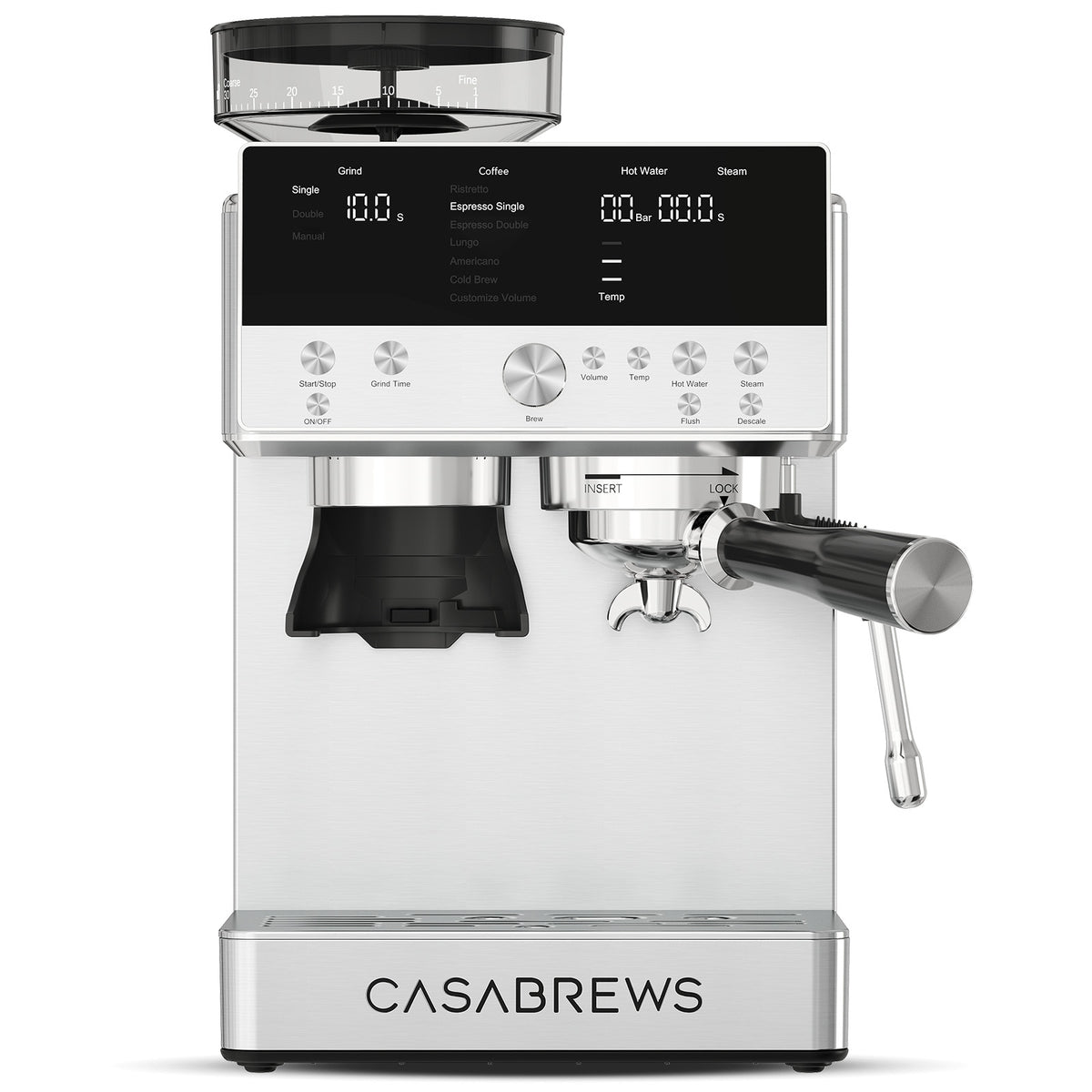
MARENZA™
$299.99
CASABREWS Marenza™ shines as a premier choice among all-in-one espresso machines on the market, a reflection of its integrated versatility and superior brewing excellence.
Machine Type: Manual, Semi-Automatic, Automatic, and Super-Automatic Machines
The Specialty Coffee Association defines espresso machine types according to who performs each part of the brewing process:
- Manual or lever machine: The user operates a lever to generate the pressure needed for brewing. This provides direct control but requires close attention and technique.
- Semi-automatic machine: The user manually starts and stops the extraction. Grinding, dosing, tamping, and milk preparation may still be separate tasks.
- Automatic machine: The user starts the extraction, but the machine stops after a preset volume or time. “Automatic” does not necessarily mean the machine grinds or tamps the coffee.
- Super-automatic machine: The machine grinds whole beans, moves the grounds into its brewing unit, tamps, and brews. The user normally selects a drink or liquid volume. Milk handling varies by model.
These definitions come from a 2021 SCA document covering machines used at WCC/WCE competitions. They provide a useful terminology framework, but the document is not a consumer certification standard for home machines.
Many stores place portafilter machines with preset shot buttons in a broad “semi-automatic” category. Under the more precise SCA definitions, a machine that starts by button and stops at a preset volume is closer to an automatic espresso machine during the extraction step.
MARENZA should not be confused with a super-automatic machine. Its Casabrews manual documents an integrated grinder with automatic and manual grinding modes. However, the user still selects a basket, handles and tamps the portafilter, locks it into the group head, and operates the manual steam wand. It is more accurately described as a grinder-equipped, all-in-one portafilter system.
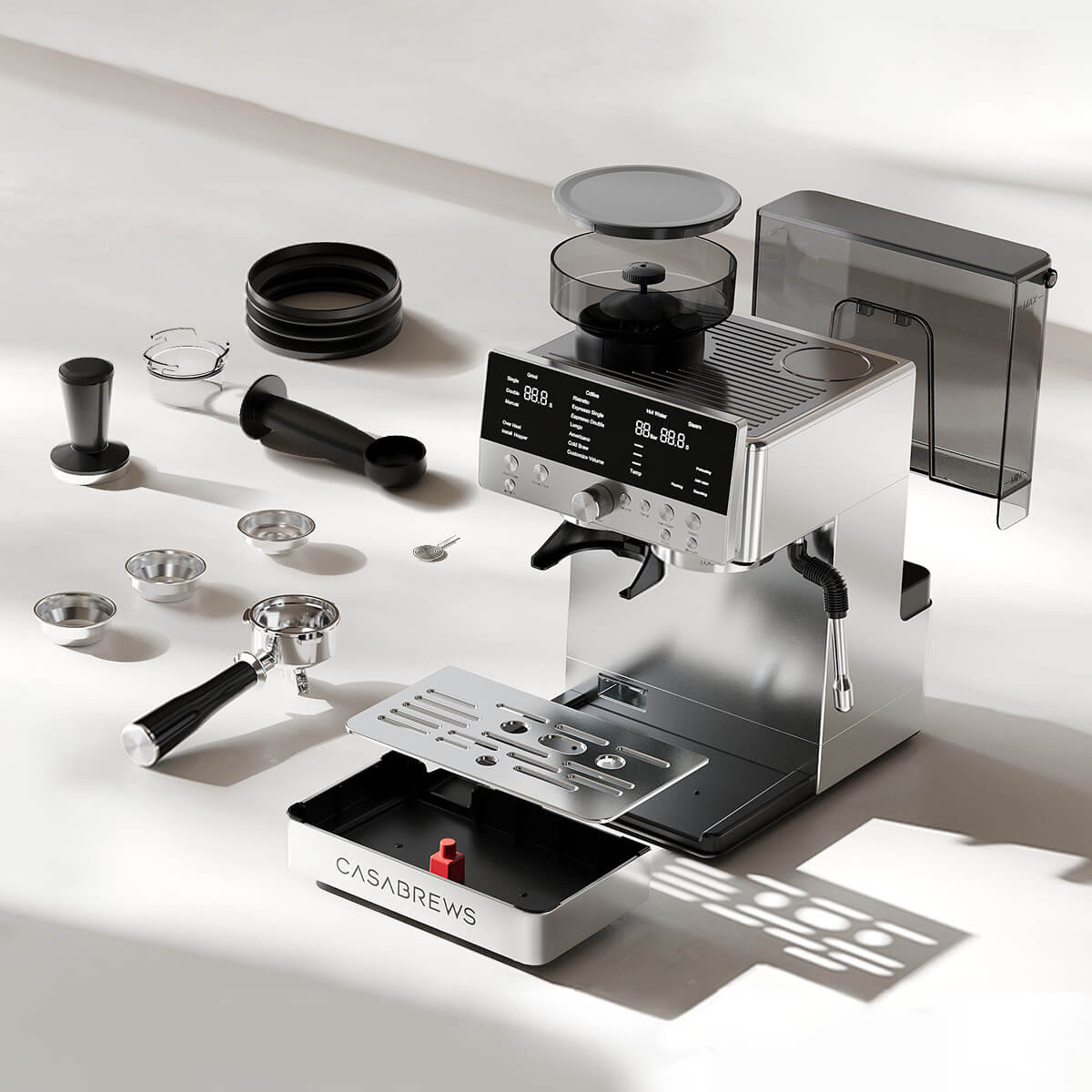
When comparing any espresso machine for home use, set the category label aside and read the operating steps. The workflow tells you more about the daily workload than words such as “automatic” or “professional” in a product name.
Machine Purchase Type: First Machine or Upgrade
If this is your first machine, focus on whether you can understand and maintain the workflow. Check what the machine includes, whether it supports pre-ground coffee, whether you need a separate grinder, how milk is frothed, and what must be cleaned after each drink.
If you are replacing an existing machine, identify its specific limitation:
- Are you waiting between brewing and steaming?
- Do you want clearer feedback while dialing in espresso?
- Do you need adjustable brew temperature or shot volume?
- Is your grinder the likely source of inconsistent flow?
- Is the water tank difficult to refill?
- Do you want fewer separate appliances?
- Are repeated drinks interrupting your workflow?
Choose an upgrade only when its documented functions address that limitation.
For example, ULTRA provides adjustable brew temperature, adjustable shot volume, an LCD, and a shot timer, according to its product documentation from Casabrews. Those controls may be relevant if your current problem is limited feedback or adjustability. They do not remove the need for a suitable grinder or consistent preparation.

ULTRA™
$209.99
CASABREWS ULTRA™ emerges as an accessible yet powerful choice among home espresso machines on the market, a reflection of its intuitive LCD control and café-quality brewing excellence.
Set a Total Budget, Not Just a Machine Budget
The price of the machine is not the full cost of making espresso at home. Your setup may also need a grinder, scale, milk pitcher, cleaning products, water treatment, and compatible accessories.
Start by deciding which parts you already own. Then divide your budget between the machine, grinder, and supporting equipment. Avoid spending the entire amount on features that cannot compensate for an unsuitable grinder or an inconvenient workflow.
Build Your Budget Around the Grinder Path
If you plan to use whole beans, choose your grinder path before choosing the machine:
- Separate grinder: Gives you more freedom to upgrade either appliance later. It also requires additional money and counter space.
- Integrated grinder: Reduces the number of separate appliances and keeps grinding and brewing in one station. You still need to adjust the grinder as the coffee, roast, and environment change.
- Pre-ground coffee: Avoids buying a grinder, but gives you less control over grind size and freshness. A compatible dual-wall or pressurized basket can make this workflow more forgiving.
The number of grind settings is not enough to judge a grinder. What matters is whether the grinder can make small, repeatable adjustments in the espresso range.
A 2024 study from a Zurich University of Applied Sciences research team found that both the median particle size and the proportion of particles smaller than 100 µm contributed to espresso extraction time. The study used one coffee, one commercial grinder, one commercial espresso machine, and three repetitions per preparation. It does not establish which home grinder is best, but it shows why grind distribution matters beyond the advertised number of settings.
A separate modeling and café experiment published through the University of Portsmouth found lower extraction yields at both very coarse and very fine settings. At the fine end of that experiment, uneven flow and poor repeatability became important. The equipment, recipe, and pressure were specific to the study, so the result should not be turned into one universal grind setting. The practical lesson is simpler: finer is not always better, and useful adjustment matters more than a large marketing number.
If you already own a capable espresso grinder, you can direct more of your budget toward the machine. If you do not own one, compare the price and space requirements of a separate grinder with an all-in-one system.
Include Essential Accessories and Care Costs
Check what comes in the box before adding accessories to your budget. A workable starting setup may require:
- A basket that matches how you buy coffee
- A correctly sized tamper
- A scale that can fit under the cup
- A milk pitcher if you make milk drinks
- A cleaning brush or steam-wand needle
- Manufacturer-compatible cleaning or descaling products
- Water treatment appropriate for your local water and machine
Do not assume every accessory labeled 51mm or 58mm will fit every machine with the same nominal size. Portafilter ears, basket depth, handle geometry, and group-head design can differ. Use a documented compatibility list whenever possible.
Optional tools such as dosing funnels, distribution tools, bottomless portafilters, and puck screens can be added later. They should solve a specific preparation or cleaning problem rather than inflate the initial budget.
Avoid building a savings estimate around an assumed café price or a universal cost per cup. A credible calculation would need current local drink prices, coffee and milk use, cleaning supplies, water treatment, electricity, and equipment life. Those inputs vary too much for one unsupported number to guide every buyer.
Match the Machine to Your Drinks and Daily Volume
The drinks you make determine which parts of the machine you will use most. Straight espresso places more attention on grinding, dosing, brew ratio, and temperature. Milk drinks add steaming and cleaning. Americanos need a convenient hot-water path.
Daily volume matters too. One espresso each morning does not create the same workload as four lattes prepared in a row.
Espresso, Americano, or Milk Drinks?

If you mostly drink straight espresso, prioritize the controls that help you repeat a recipe:
- Adjustable or programmable shot volume
- Enough grind adjustment for the coffee you use
- Baskets that match your experience and grinder
- Clear timing or pressure feedback, if you will use it
- Documented brew-temperature control
A 2023 study from the Technical University of Munich examined flow rate, grind setting, water temperature, and brew ratio. Within its experimental range, brew-ratio changes had a larger effect on measured cup composition than the other parameters. The authors recommended controlling brew ratio accurately before fine-tuning flow, grinding, and temperature.
This does not mean every espresso should use the same ratio. It means a small scale can be more useful than an extra feature you do not know how to measure.
For Americanos, check how the machine dispenses hot water. Some machines use the steam wand, while others provide a dedicated control or automated drink program. Consider whether you must move the cup, turn a valve, or stop the water manually.
For lattes, cappuccinos, and other milk drinks, examine the entire milk workflow:
- Pull the espresso.
- Activate or prepare steam mode.
- Wait until the machine is ready, if required.
- Texture the milk.
- Stop the steam.
- Purge and wipe the steam wand.
- Return the machine to brew temperature if another espresso is needed.
A manual steam wand gives you direct control over milk texture, but it requires practice and immediate cleaning. Do not rely only on phrases such as “powerful steam” or “microfoam ready.” Look for a documented steam procedure and, where available, a test that states the milk volume, starting conditions, target temperature, and elapsed time.
If You Make Several Drinks Back to Back
For repeated drinks, the most useful question is not simply “How fast does it heat up?” Ask how the machine behaves across the complete sequence.
Look for evidence covering:
- Initial readiness for brewing
- Time from brewing to usable steam
- Time from steaming back to brewing
- Temperature recovery between shots
- Water-tank capacity and refill access
- Drip-tray capacity
- Automatic cutoffs or cooling steps
- Steam-wand cleaning between drinks
The Specialty Coffee Association evaluates professional competition machines through controlled temperature measurements, repeated duty cycles, and a steaming test that measures the time needed to heat 300 cm³ of milk to 60°C. Its 2021 document applies to WCC/WCE competition machines, not home products, but the test design shows why a single initial heat-up figure cannot describe total drink-making performance.
Read the Specifications That Affect Everyday Use
A specification is useful only when you understand what it changes. Focus on measurements that affect preparation, compatibility, cleaning, and counter fit. Treat broad performance language more cautiously.
Pressure, Temperature Stability, and Pre-Infusion
Pump pressure is one of the most misunderstood espresso machine specifications.
A label such as “20-bar pump” normally describes the pump’s maximum rating. It does not tell you the exact pressure at the coffee bed during every shot, and it does not show that one machine will produce better espresso than a machine with a lower maximum rating.
Pressure works together with:
- Grind size and particle distribution
- Coffee dose
- Basket and puck resistance
- Tamping and puck preparation
- Water flow
- Beverage output
The University of Portsmouth study cited earlier found that changing grind, dose, and pressure altered flow and extraction together. Its café experiment encountered clogging at fine settings when the test machine was set to 9 bar, so the researchers reduced it to 6 bar to cover a wider experimental range. Flavor differences were not quantified. The study therefore supports treating pressure as part of a system, not recommending 6 bar or any other pressure for every coffee.
Temperature specifications require similar care. The SCA competition-machine document sets an average brew-temperature range of 90.5–96°C and a maximum individual-group reproducibility value of 1.1°C. Those figures apply to the document’s professional competition scope. They should not be presented as proof that a Casabrews model meets the standard.
For a home espresso machine, ask:
- Is brew temperature controlled or adjustable?
- Is the stated temperature measured near the coffee bed?
- Does the manufacturer publish a test method?
- Is the result an adjustable set point or measured stability?
- Does the machine require a cooling step after steaming?
Pre-infusion introduces water at lower pressure before the main extraction. It can be a useful control, but the confirmed evidence does not show that having pre-infusion guarantees a better shot. Treat it as one tool among grind, dose, distribution, flow, temperature, and beverage weight.
Portafilter Size, Basket Type, and Accessory Compatibility
Common home portafilter diameters include 51mm and 58mm, but the diameter alone does not establish extraction quality.

The SCA competition-machine specification requires manufacturers to disclose nominal portafilter diameter. It does not state that a larger diameter automatically produces better espresso.
Portafilter size affects practical matters such as:
- Which baskets and tampers fit
- How much space the handle needs
- Which replacement parts are available
- Whether existing accessories can move to a new machine
Basket type can have a more immediate effect on workflow:
- Dual-wall or pressurized baskets regulate flow through an additional outlet or pressure mechanism. They can be more forgiving with pre-ground coffee or less precise grinding.
- Single-wall or non-pressurized baskets place more responsibility on grind size, dose, distribution, and tamping. They provide more room for adjustment but do not guarantee a better result.
We recommends dual-wall baskets for beginners, pre-ground coffee, coarser grinds, and less controlled dosing. It recommends single-wall baskets for users who want more control with freshly ground coffee. That guidance is specific to MARENZA, but it provides a useful example of how basket choice changes the workflow.
Before buying accessories, confirm the exact model and basket dimensions. Nominal diameter is a starting point, not a complete compatibility guarantee.
Measure Your Space, Water Access, and Electrical Setup
Measure the space as the machine will actually be used.
Record:
- Available counter width
- Counter depth
- Clearance under cabinets
- Space needed to insert and rotate the portafilter
- Steam-wand movement
- Water-tank removal direction
- Bean-hopper access
- Distance to an electrical outlet
Compare these measurements with the manufacturer’s width, depth, and height. Check the order in which dimensions are presented instead of assuming every page uses the same format.
Also verify voltage and frequency for the exact market version. A U.S. machine should be documented for the electrical supply where it will be used. Do not assume a visually identical model sold in another country has the same voltage.
Water-tank capacity matters only in context. A larger tank may reduce refills, but it can also increase machine size. Refill direction can be more important than volume when the machine sits under a cabinet.
Check Cleaning, Water, Warranty, and Support Before You Buy
Cleaning is part of the ownership experience. A machine that fits your drink routine but not your maintenance routine is unlikely to remain convenient.
Read the cleaning section of the manual before buying. Check which tasks happen after every drink, which happen periodically, and which require a special tablet, solution, basket, or tool.
Cleaning and Descaling Workload
Routine care may include:
- Emptying and rinsing the basket
- Cleaning the portafilter
- Wiping and purging the steam wand
- Emptying the drip tray
- Flushing the brew head
- Cleaning coffee oils from internal surfaces
- Descaling the water path
- Cleaning an integrated grinder
Milk residue should be handled immediately. Both the CM5418 and 5418 PRO manuals instruct users to purge and wipe the steam wand after frothing. Waiting allows milk residue to dry and makes blockage more likely.
The same manuals show a descaling reminder after 500 brew cycles. That is a model-specific reminder, not a universal interval for every machine or water supply.
Water hardness also affects scale formation. The U.S. Geological Survey explains that hardness mainly reflects dissolved calcium and magnesium. When hard water is heated, calcium carbonate deposits can form in equipment, including coffee makers.
USGS provides these general classifications, measured as calcium carbonate:
- 0–60 mg/L: soft
- 61–120 mg/L: moderately hard
- 121–180 mg/L: hard
- More than 180 mg/L: very hard
The USGS also warns that its national and regional maps should not guide decisions for an individual home. Obtain local information from your water utility or a suitable water test, then follow the machine manual. Do not choose a filter, descaling product, or schedule based only on a national map.
Certification, Warranty, Parts, and Returns
Treat safety and environmental certifications as document-based claims. A complete certification record should identify the issuing organization, certificate or listing number, applicable standard, exact model, and current status.
Do not rely on a logo or a general phrase such as “certified safety” when that information is unavailable.
Warranty coverage also needs more detail than its duration. The current Casabrews Warranty Policy states:
- Coverage generally lasts 12 months from the original purchase date.
- Valid proof of purchase is required.
- Coverage generally applies in the original country of purchase.
- Eligible remedies may include troubleshooting, parts, repair, replacement, or refund, with the remedy determined by Casabrews.
- Products bought directly from casabrews.com may be handled under a 30-day money-back guarantee after delivery.
- Products bought from another retailer remain subject to that retailer’s return policy during its return period.
- Normal-wear items and consumables are generally excluded unless defective at delivery.
- Failures caused by insufficient descaling, mineral buildup, blocked passages, milk residue, or improper cleaning may be excluded.
Which Casabrews Espresso Machine Fits Your Needs?
Casabrews models should be compared by documented workflow and configuration, not by an unsupported quality ranking. Begin with whether you need a grinder, which basket path you prefer, and how much feedback you want while brewing.
CM5418 or 3700ESSENTIAL for a Simpler Starting Point
CM5418 and 3700ESSENTIAL both use a compact portafilter-based workflow with preset single- and double-shot controls and manual milk frothing.
Casabrews CM5418 Features
- A 51mm aluminum portafilter
- Dual-wall filter baskets
- Preset single and double shots
- Adjustable shot volume
- Manual milk frothing
- A 34 oz removable water tank
- U.S. electrical specifications of 120V and 1350W
- Dimensions of 5.47 × 12.28 × 11.97 inches
This configuration may suit a buyer who wants a compact machine, plans to use pre-ground coffee or a separate grinder, and prefers a guided dual-wall basket workflow.
Casabrews 3700ESSENTIAL Features:
- A 51mm portafilter
- Dual-wall baskets
- Preset single and double shots
- Adjustable shot volume
- Simple button controls
- Manual milk frothing
- U.S. electrical specifications of 120V and 1350W
- Dimensions of 5.7 × 12.6 × 12.5 inches
Neither machine has a documented integrated grinder in the confirmed evidence package. Include a separate grinder in your plan if you want to use whole beans and adjust the grind.
5418 PRO for Faster Daily Workflow
The confirmed evidence does not establish that 5418 PRO completes an entire drink faster than the other models. Its relevant documented differences are the controls and feedback available during the workflow.
Casabrews 5418PRO Features:
- A pressure gauge
- A 51mm portafilter
- One-cup and two-cup dual-wall baskets
- Automatic stopping for preset shots
- Programmable shot volumes from 20 to 160 mL
- Manual milk frothing
- A 34 oz water tank
- U.S. specifications of 120V/60Hz and 1550W
- A descaling reminder after 500 brew cycles
This model may fit a buyer who wants a compact, separate-grinder setup with visible pressure feedback and programmable output.
ULTRA or MARENZA for More Control or an All-in-One Setup
ULTRA and MARENZA serve different equipment plans.
Casabrews ULTRA Features:
- A 58mm portafilter
- Two pressurized and two non-pressurized baskets
- Adjustable brew temperature
- Adjustable shot volume
- An LCD with a shot timer
- Low-pressure pre-infusion
- Manual milk frothing
- A 2.0 L removable water tank
- U.S. electrical specifications of 120V/60Hz
- No integrated grinder
ULTRA may suit someone who already owns or plans to buy a separate grinder and wants more visible brewing feedback and adjustment.
MARENZA follows an all-in-one equipment path. Its features are as follows:
- An integrated grinder with automatic and manual dosing modes
- A 58mm portafilter
- Dual-wall and single-wall baskets
- Adjustable grind, temperature, and drink volume
- Programs for ristretto, espresso, lungo, Americano, and cold brew
- Manual milk frothing
- A 1.7 L water tank and 180 g bean hopper
- U.S. electrical specifications of 120V/60Hz and 1450W
MARENZA may suit a buyer who wants the grinder and espresso machine in one unit while retaining a hands-on portafilter workflow. It is not a super-automatic machine because the user still manages the basket, portafilter, tamping, and milk.
Use This Final Checklist Before You Buy
Before choosing an espresso machine for home use, confirm each item you care about:
- Drinks: Do you mainly make espresso, Americanos, or milk drinks?
- Workflow: Who will grind, dose, tamp, stop the shot, and froth milk?
- Grinder: Do you already own an espresso-capable grinder?
- Coffee: Will you use whole beans or pre-ground coffee?
- Baskets: Does the machine include dual-wall, single-wall, or both?
- Controls: Will you use adjustable temperature, shot volume, a timer, or a pressure display?
- Daily volume: Is the documented workflow practical for the number of drinks you make?
- Space: Have you measured width, depth, height, refill clearance, and portafilter movement?
- Electrical supply: Is the exact model designed for U.S. voltage and frequency?
- Water: Do you know your local water hardness and the manufacturer’s maintenance instructions?
- Cleaning: Are you willing to purge the steam wand, rinse the portafilter, empty the drip tray, and descale as directed?
- Accessories: Are compatible baskets, tampers, seals, and replacement portafilters available?
- Warranty: Have you checked the seller, proof-of-purchase requirement, return window, exclusions, and original-country limitation?
- Evidence: Are performance, certification, safety, cost, and environmental claims supported by a test method or identifiable document?
- Upgrade purpose: Can you name the specific problem the new machine will solve?
If a feature does not improve your actual workflow, it should not decide the purchase. Choose the machine, grinder path, baskets, and maintenance routine as one home espresso system.
FAQs About Choosing an Espresso Machine for Home Use
Is a 15-bar or 20-bar espresso machine better than a 9-bar machine?
Not necessarily. A 15-bar or 20-bar label usually refers to the pump’s maximum rating. It does not show the exact pressure at the coffee bed or prove that the machine will make better espresso.
Grind size, dose, basket resistance, water flow, pressure, and beverage output interact during extraction. Research available through the University of Portsmouth found that changing grind, dose, and pressure affected flow and extraction together under its specific café test conditions.
The Specialty Coffee Association also tests pressure under controlled flow conditions rather than treating maximum pump pressure as a stand-alone quality measure. Its document applies to professional competition machines, not consumer product rankings.
Is a 58mm portafilter better for home espresso?
A 58mm portafilter is not automatically better than a 51mm or 54mm portafilter. Diameter mainly affects basket, tamper, and accessory compatibility.
The Specialty Coffee Association requires nominal portafilter diameter to be disclosed in its competition-machine specification, but it does not state that a larger diameter guarantees better extraction.
Choose a size with suitable baskets and available replacement parts. Confirm compatibility for the exact machine because accessories with the same nominal diameter may still differ in shape or fit.
When is it worth upgrading from an entry-level espresso machine?
Upgrade when you can identify a specific limitation that the new machine will address.
A change may be worthwhile if you need:
- More useful temperature or shot-volume adjustment
- Clearer timing or pressure feedback
- A different basket or accessory system
- A more convenient grinder workflow
- Easier water access
- A better-documented repeated-drink workflow
- Replacement parts that are easier to obtain
First check whether the real limitation is the machine, grinder, coffee preparation, water, or cleaning routine. Extra features will not solve a grind problem or inconsistent dosing unless they change that part of the workflow.
Is a built-in grinder better than a separate grinder?
Neither option is automatically better.
A built-in grinder keeps grinding and brewing in one machine and may reduce the number of separate appliances on your counter. A separate grinder gives you more freedom to choose, position, repair, or upgrade the grinder and espresso machine independently.
Compare the grinder’s adjustment range, dosing controls, cleaning access, and replacement options. Do not decide based only on the advertised number of grind settings.


